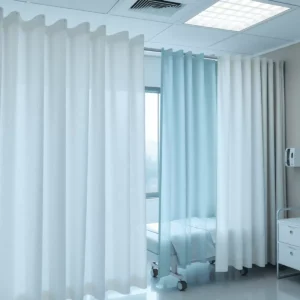
Hospital operations depend on hundreds of small tasks being completed efficiently every day. From patient admissions and discharges to room cleaning and equipment preparation, every minute matters. While many healthcare facilities focus on improving clinical workflows and patient care, one routine maintenance task is increasingly attracting attention: replacing hospital privacy curtains.
Although privacy curtains are essential for maintaining patient dignity and supporting infection prevention efforts, traditional curtain replacement methods can consume valuable staff time. Environmental services (EVS) teams often manage dozens of responsibilities during each shift, making even routine maintenance tasks challenging to complete on schedule.
As hospitals continue searching for practical ways to improve operational efficiency, many are turning to quick-change curtain systems that simplify this routine process. By reducing replacement time and minimizing disruption, these systems help healthcare facilities streamline workflows while maintaining high standards of cleanliness and patient care.
Why Traditional Curtain Replacement Can Be Inefficient
Conventional privacy curtains are typically attached to ceiling tracks using hooks or snap fasteners. Replacing them often requires a ladder, overhead work, and, in many cases, assistance from another staff member.
For environmental services teams managing multiple patient rooms, replacing even a single curtain can take 20 to 40 minutes. Across an entire healthcare facility, this represents a considerable investment of labor and room downtime.
When hospitals are operating near capacity, delaying patient admissions because a room is unavailable can create workflow challenges throughout the facility. Staff may need to wait until curtain replacement is complete before final room preparation can begin, slowing patient turnover and increasing pressure on busy departments.
The challenge is not that healthcare teams underestimate the importance of clean privacy curtains. Instead, traditional replacement methods simply require more time and effort than many facilities can easily spare during busy operational periods.
A Smarter Approach to Curtain Replacement
To address these operational challenges, many healthcare facilities are adopting quick-change curtain systems that separate the removable fabric panel from the ceiling-mounted header.
Instead of removing the entire curtain assembly, staff simply unzip the fabric panel and attach a clean replacement while the header remains securely connected to the existing track.
This design eliminates several unnecessary steps, allowing a single team member to complete the replacement quickly without special tools or extensive setup.
Healthcare facilities exploring modern hospital privacy curtains are increasingly considering ease of maintenance alongside durability and patient privacy.
Improving Staff Productivity
Hospitals continuously seek opportunities to improve efficiency without increasing staffing levels.
Reducing the time required for routine maintenance allows environmental services teams to focus on higher-priority responsibilities, including terminal cleaning, infection prevention, and preparing patient rooms for new admissions.
Although replacing privacy curtains may seem like a small task, simplifying the process across hundreds of rooms can save significant labor hours over the course of a year.
Supporting Infection Prevention
Routine curtain replacement plays an important role in maintaining a clean healthcare environment. Privacy curtains are touched frequently throughout the day by patients, visitors, and healthcare workers, making them part of a hospital’s broader environmental hygiene strategy.
Faster replacement systems make it easier for hospitals to follow established maintenance schedules because the process requires less time and fewer resources.
Rather than postponing curtain changes due to operational constraints, staff can complete the task with minimal disruption to patient care.
Disposable Curtains for High-Risk Areas
Many hospitals also use disposable hospital curtains in emergency departments, isolation rooms, and other high-turnover environments.
Disposable curtain panels eliminate laundering requirements and allow facilities to replace contaminated curtains immediately when needed.
Using reusable curtains in standard patient rooms and disposable curtains in higher-risk clinical areas enables hospitals to balance operational efficiency with infection prevention objectives.
Looking Beyond the Product
Healthcare facilities evaluating curtain systems are increasingly focusing on long-term operational value rather than simply the initial purchase price.
Questions such as:
- How quickly can staff replace a curtain?
- Does the system require ladders?
- Can one person complete the task?
- Does it work with existing ceiling tracks?
are becoming just as important as material quality and appearance.
Solutions like ZipQuick Curtains reflect this shift by helping healthcare facilities modernize routine maintenance without requiring major infrastructure changes.
The Long-Term Benefits of Operational Efficiency
Operational improvements are often measured not by dramatic changes, but by consistent gains across everyday activities.
When hospitals reduce the time required for repetitive maintenance tasks, they create opportunities to improve productivity throughout the organization. Faster room turnover, improved staff utilization, reduced maintenance delays, and better compliance with cleaning schedules all contribute to smoother hospital operations.
Over time, these incremental improvements can positively affect patient satisfaction, staff morale, and the overall efficiency of healthcare delivery.
As hospitals continue investing in process improvements, solutions that simplify routine maintenance are becoming an increasingly important part of facility management strategies.
Conclusion
Hospital efficiency often depends on improving the small, repetitive tasks that occur every day. Privacy curtain replacement may seem like a minor maintenance responsibility, but when multiplied across hundreds of patient rooms, the time required becomes significant.
Quick-change curtain systems offer a practical way to reduce maintenance time, support infection prevention, improve workplace safety, and enhance staff productivity without disrupting patient care.
As hospitals continue investing in operational excellence, simplifying routine curtain replacement is becoming an increasingly valuable part of modern healthcare facility management. By adopting solutions that make everyday tasks faster and more efficient, healthcare organizations can better support both their staff and the patients they serve.