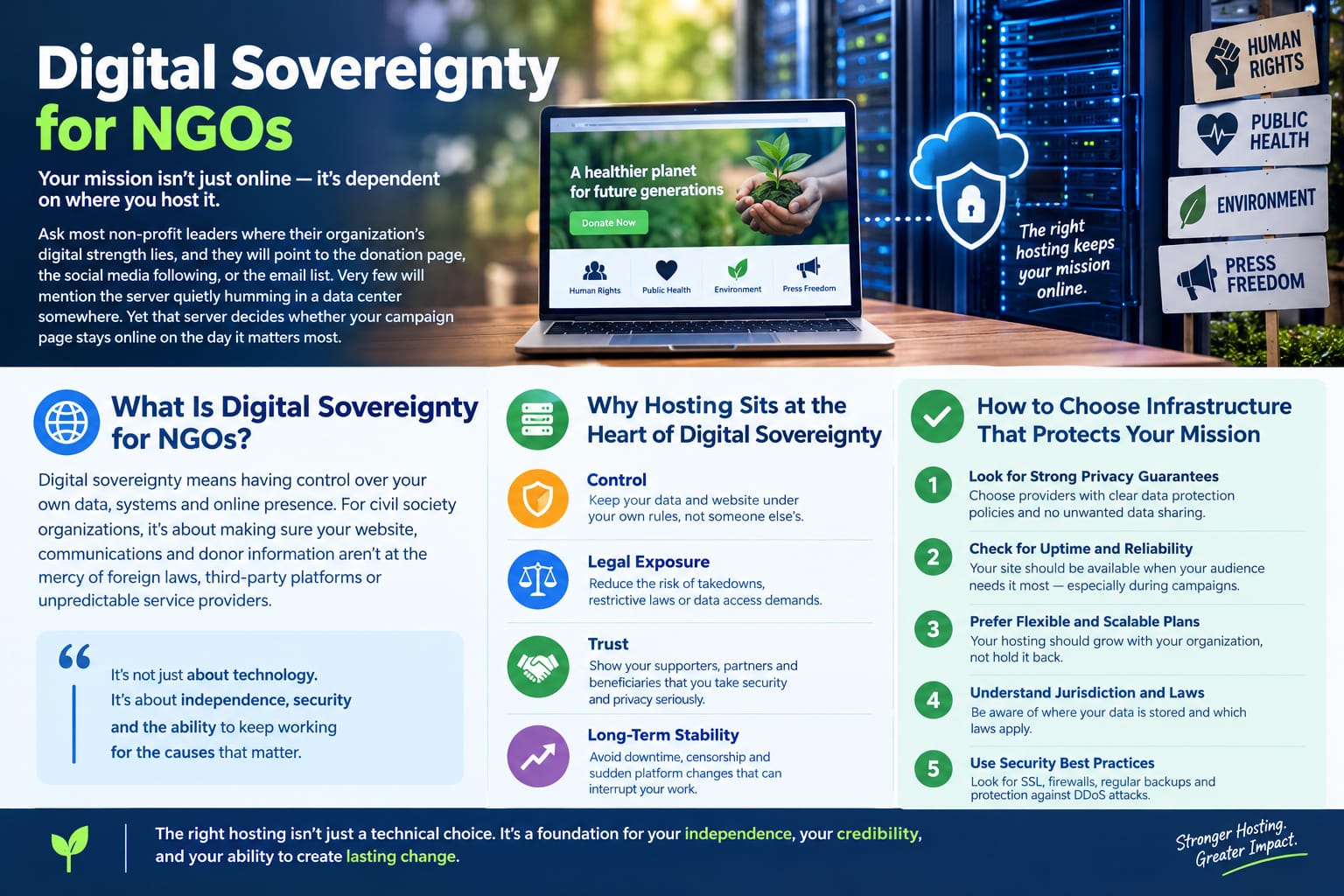
Ask most non-profit leaders where their organization’s digital strength lies, and they will point to the donation page, the social media following, or the email list.
Very few will mention the server quietly humming in a data center somewhere. Yet that server decides whether your campaign page stays online on the day it matters most.
Where a website lives is no longer a purely technical footnote. For NGOs working on human rights, public health, the environment, or press freedom, hosting has become a question of control, legal exposure, and trust.
This article explains what digital sovereignty means for civil society organizations, why hosting sits at the heart of it, and how to choose infrastructure that protects your mission.
What Digital Sovereignty Means for NGOs?
Digital sovereignty is the ability of an organization to control its own data, systems, and online presence without depending on the goodwill of a single provider, platform, or government.
For states, the term often relates to national cloud strategies. For NGOs, it is more practical: Can someone else switch off our website, read our records, or force us to remove content without a fair process?
Beyond Data Protection
Data protection laws such as the GDPR tell organizations how personal data must be handled. Sovereignty goes one step further. It asks who holds the keys, which country’s laws apply to the servers, and what happens when a third party objects to your content. An NGO can be fully compliant on paper and still be vulnerable if its hosting arrangement gives others the power to disrupt it overnight.
Why Hosting Is the Overlooked Layer of NGO Security?
NGOs usually invest in visible protections: strong passwords, two-factor authentication, secure email. Hosting tends to be chosen early, often on price alone, and rarely revisited. But the host controls the physical servers, the network, the backups, and the legal relationship under which your site operates. If that layer fails or is pressured, everything built on top of it goes with it.
Websites are also the main evidence of an NGO’s work. Reports, investigations, testimonies, donor information, and archives all sit there. Losing access, even temporarily, can interrupt fundraising, damage credibility, and put vulnerable people at risk.
Real Risks NGOs Face
Jurisdiction and Legal Pressure
Every server sits under a legal system. If your host operates in a country with broad takedown powers or weak procedural safeguards, a single complaint can lead to suspension before you have had a chance to respond. Organizations documenting corruption, environmental damage, or abuses are especially exposed to this kind of pressure.
Takedown Abuse and False Claims
Copyright and content-removal systems exist for good reasons, but they can be misused. Powerful actors sometimes file inaccurate or exaggerated claims to silence critical reporting or remove inconvenient documents. When a hosting provider’s policy is to suspend first and ask questions later, NGOs carry the burden of proving their innocence while their content stays offline.
Provider Dependency and Sudden Suspension
Many organizations rely on large, automated platforms with little human support. Policy changes, automated flagging, or account reviews can lock out customers with minimal explanation. For a small NGO with no technical team, recovering access can take days or weeks.
Exposure of Supporter and Beneficiary Data
Donor lists, volunteer details, and case records are sensitive. In some contexts, a leak does not merely cause embarrassment; it can endanger people. Hosting that lacks strong privacy practices or sits in a jurisdiction with intrusive data-access laws raises that risk.
What to Look for in an NGO-Ready Hosting Provider?
Choosing a host is easier when you know which questions to ask. These are the factors that matter most for civil society organizations.
Jurisdiction and Legal Framework
Look for a provider based in a country with strong privacy law, independent courts, and clear due-process rules for content complaints. Within Europe, the Netherlands is a well-regarded location thanks to its mature internet infrastructure and EU-level data protection framework.
Transparent Handling of Complaints
A good host reads a complaint, verifies that it is legally valid, and gives the customer a chance to respond. Ask providers how they handle notices, how quickly they communicate, and whether they take action based on valid legal process rather than unverified claims. Lawful content should not disappear because of an unsupported accusation.
Infrastructure Quality
Reliability is a form of sovereignty too. A site that is frequently down cannot serve its community.
Data Center Standards
Tier III facilities are designed with redundant power and cooling so that maintenance can happen without taking systems offline. This is a meaningful benchmark when you need your website available during crises and campaigns.
Backups and Recovery
Regular, independent backups mean a technical failure or attack does not erase years of work. Ask where backups are stored and how fast you can restore.
Privacy-Respecting Practices
Check what the provider logs, how it treats customer data, and whether it offers secure ways to pay and communicate. A host that collects only what it needs is easier to trust.
Support and Control
Responsive human support and an easy-to-use control panel matter more than most boards realize. A small team should be able to manage email, backups, and domains without hiring a specialist for every change.
Practical Steps NGOs Can Take This Year
You do not need a large budget to improve your position. Start with these actions:
- Audit your current hosting. Find out where your servers are located and which laws apply.
- Review the provider’s content policy. Understand how complaints are handled and what notice you would receive.
- Keep independent backups. Store copies outside your hosting account.
- Separate critical assets. Consider hosting sensitive archives or campaign sites on infrastructure chosen for resilience.
- Document a continuity plan. Know who to contact and how to migrate if something goes wrong.
Why QloudHost Is Worth Considering for NGOs?
For organizations that want hosting built around privacy and resilience, QloudHost offers a practical option. QloudHost is a web hosting company focused on offshore and privacy-oriented hosting, with its infrastructure based in the Netherlands.

DMCA Ignored and Offshore Hosting
QloudHost provides DMCA Ignored Hosting and Offshore Web Hosting designed for website owners who want their lawful content handled under a stronger jurisdictional and procedural framework. For an NGO, this can mean less exposure to hasty takedowns driven by unverified claims, while still operating within the law.
Tier III Data Center in Amsterdam
QloudHost operates a Tier III data center in Amsterdam, Netherlands. Combining a respected European location with enterprise-grade facilities gives NGOs a stable base for publishing reports, running campaigns, and protecting supporter data.
Easy Management With DirectAdmin or cPanel
Plans come with DirectAdmin as the default control panel, and cPanel is available on request for teams that already know it. That flexibility keeps day-to-day management simple for small, non-technical staff.
If your organization is reassessing where its website lives, you can explore the available plans at QloudHost and compare them against the criteria above.
Frequently Asked Questions
What is digital sovereignty in simple terms?
It is an organization’s ability to control its own data, websites, and online services without being at the mercy of a single provider or foreign legal pressure. For NGOs, it largely comes down to choosing infrastructure they can trust and, if needed, move.
Why does website hosting matter for an NGO?
Your host controls the servers that store your reports, donor data, and campaign pages. Its location, policies, and reliability determine whether your site stays online and your data stays protected.
Is offshore hosting legal for non-profits?
Yes. Hosting a website in another country is legal, provided the content and activities comply with the laws that apply. Many organizations choose a different jurisdiction specifically for stronger privacy and due-process protections.
How can NGOs protect their sites from false takedown claims?
Choose a host with a transparent complaint process, keep records of your content’s origin and permissions, and maintain independent backups. Responding promptly and with documentation also helps resolve disputes quickly.
What should an NGO check before switching hosting providers?
Review the provider’s jurisdiction, complaint-handling policy, data center standards, backup options, privacy practices, and support quality. Plan the migration carefully so the site stays live throughout the move.
Conclusion
Digital sovereignty is not an abstract policy debate. For NGOs, it is a daily operational reality that begins with a simple question: who really controls the place where our work lives online?
Choosing a host with strong jurisdiction, transparent processes, reliable infrastructure, and respect for privacy is one of the most effective steps a civil society organization can take.
Review your current setup, ask the hard questions, and build an online presence that can withstand pressure. Your mission deserves infrastructure that protects it.