A Chain Can Look Good and Still Be Annoying to Wear
A chain can look right in product photos and become annoying within an hour of putting it on. It pulls at neck hair, catches the edge of a T-shirt, or keeps twisting until the clasp works its way to the front. These problems are easy to overlook when most of the buying decision is based on width, shine, and link pattern.
The link style has a lot to do with how a men’s silver chain behaves during the day. Some links lie flat and move naturally with the neck. Others have small gaps or textured surfaces that can catch hair and fabric. A chain that feels smooth while worn may still kink if it is folded carelessly, while an intricate woven chain may be comfortable but frustrating to clean.
There is no single link style that causes zero trouble. Construction quality, width, weight, and finishing all matter. Still, some designs are more forgiving than others, especially for someone who plans to wear the chain regularly rather than keep it for occasional use.
What “Easy to Live With” Actually Means
Before calling one link style better than another, it helps to be clear about what daily convenience involves. Comfort is the first test. A chain should move with the neck without pinching skin, pulling hair, or pressing rough edges against the collarbone. Width and weight affect this, but so does the shape and finish of each link.
Then there is movement. Some chains bend freely in every direction, while others are designed mainly to lie flat. A flat chain may sit neatly against the chest but twist if it is handled roughly. More open links usually move easily, though the gaps can catch loose threads or coarse knitwear. None of these traits are obvious from a close-up product photo.
Cleaning makes a difference too. Sweat, skin oil, and polishing residue settle into small spaces between links. Simple, open constructions are usually easier to clean than dense woven patterns with dozens of tight contact points. That does not make an intricate chain unsuitable for regular use; it just means the owner will spend a little more time maintaining it.
Finally, consider how forgiving the chain is away from the neck. A chain that kinks after being folded into a pocket or dropped into a travel bag demands more careful handling. Durability and convenience are not quite the same thing. A strong, substantial chain can still catch hair or take longer to clean, while a smooth and comfortable design may need cautious storage.
How Common Link Profiles Behave During a Normal Day
A link name does not tell you everything about comfort. Two curb chains can behave differently if one is thin and loosely linked while the other is wide and tightly assembled. Still, each construction has a few habits worth knowing before choosing a silver chain for men who plan to wear it regularly.
Curb and Cuban links are among the easier styles to manage. The links are twisted so they lie in a relatively flat row, which helps the chain sit close to the neck instead of rolling around. Their exposed surfaces are also fairly easy to wipe and polish. Very thick versions can feel stiff, though, especially if the links are packed closely together. Check the edges as well. A well-finished Cuban chain should feel smooth when drawn lightly across the skin; rough edges or poorly aligned links may pull hair.
Box chains have a clean, even profile and usually move in a predictable way. Round box chains can feel particularly smooth against the neck and work well with pendants. The drawback is their response to sharp bends. A thin box chain can develop a kink if it is folded tightly or pulled from a knot. Once that happens, the damaged section may remain visible even after the chain is straightened.
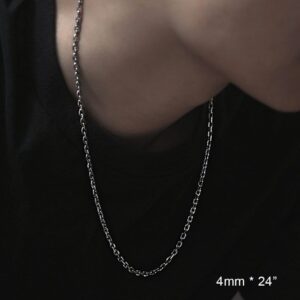
Anchor, cable, and other open-link chains tend to move freely because each link has room to turn. The open structure also makes it easier to reach between the links while cleaning. These styles are generally forgiving of ordinary handling, but larger gaps may catch loose threads, sweater fibers, or coarse knitwear. That is rarely a problem against bare skin or a smooth cotton shirt, but it is worth considering if the chain will be worn over clothing.
Wheat, rope, Byzantine, and other woven chains feel substantial because their links create a dense, rounded structure. A well-made wheat chain can move smoothly without presenting many sharp edges. Rope and Byzantine designs have more surface texture, so their comfort depends heavily on link size and finishing. They may catch chest hair, and the many small spaces collect more skin oil and polishing residue. Cleaning them is not difficult, but it takes longer than wiping down a simple curb chain.
Snake and flat snake chains offer perhaps the smoothest surface of the group. They slide over skin and most fabrics with little resistance. Their weakness shows up during storage rather than wear. A sharp fold can leave a permanent kink or dent in the continuous surface, and repairs are not always straightforward.
For the easiest overall balance, many men do well with a smoothly finished curb, Cuban, or simple open-link chain. More intricate styles can be just as wearable, but they usually ask for a bit more attention.
Match the Link to How You Actually Wear It
A chain worn against bare skin has a different job from one worn over a sweater. For all-day contact with the neck, smooth edges and easy movement matter most. Curb, Cuban, and wheat chains often work well here, provided the links are properly finished. Highly textured links may still be comfortable, but men with a lot of chest or neck hair should test them more carefully.
Wearing a chain over clothing changes the problem. Open links and raised details can catch loose fibers, particularly on wool, fleece, and loosely knitted shirts. A flat chain with a smooth back is less likely to snag, although very wide styles can shift or flip as the fabric moves. Under a collared shirt, moderate width is usually easier to manage than a heavy chain that presses against the collar or refuses to follow the neckline.
If the chain will carry a pendant, flexibility and balance matter more than visual detail. The chain needs to move freely enough for the pendant to settle in the center. Check the clasp and end fittings too. A 4mm chain may seem suitable for a pendant, but the end cap could be too large to pass through its bail.
Men who rarely remove their chains may prefer a straightforward construction that is comfortable during long wear and easy to clean. Someone who takes a chain off every night has more freedom to choose an intricate style that needs occasional extra care.
Storage habits count as well. Snake and thin box chains should not be folded into a pocket or packed loosely in a travel bag. More articulated links are generally more forgiving.
Remember that width can change the behavior of the same design. A slim Cuban chain may feel soft and flexible, while a much heavier Cuban can be noticeably stiffer. Choose based on the actual chain, not just the link name.
What to Check Before Buying a Chain Online
Start with the measurements, not the close-up photo. A chain photographed from a few inches away can look much heavier than it does on a person. Check both width and length, then look for a gram weight if one is provided. Weight can help explain why two chains with similar dimensions have very different prices or feel different on the neck.
Read the material description closely. “Silver tone” usually describes color, while “silver plated” means there is a thin silver layer over another metal. If you want sterling silver throughout, the listing should say solid 925 sterling silver or use equally clear wording. Jewelry1000, for example, identifies the metal, width, length, and link design on its chain listings.
Product photos should show more than the front of the chain. Look at the sides of the links, the soldered joints, the clasp, and the fittings beside the clasp. These areas often reveal whether the chain is smoothly finished and whether a pendant can slide on without removing any hardware.
Customer reviews can also expose problems that measurements miss. Repeated complaints about hair pulling, stiffness, kinking, or a clasp moving to the front are more useful than general comments about appearance.
Spend a few minutes comparing different men’s silver chain constructions before settling on a link style. Seeing flat, rounded, open, and woven designs side by side makes their practical differences easier to recognize.
For a gift, a moderate width and a familiar articulated link are usually safer than an extremely wide or intricate design. Unless you know the recipient already likes bold jewelry, choose the option that will be easiest for him to wear without thinking about it.
Choose the Trade-Off You Will Notice Least
Most people do not need a chain that wins every durability test. They need one that stays comfortable, does not catch on their usual clothes, and can be cleaned without becoming a weekend project.
For many men, a smoothly finished curb, Cuban, or simple open-link chain offers the most practical balance. Snake chains feel especially smooth but need careful storage to avoid kinks. Dense woven styles provide more texture and weight, though they usually take longer to clean and may pull hair.
Think about which drawback will bother you least. The easiest everyday chain is rarely the most elaborate one. It is the chain that suits your clothing, wearing habits, and willingness to look after it.