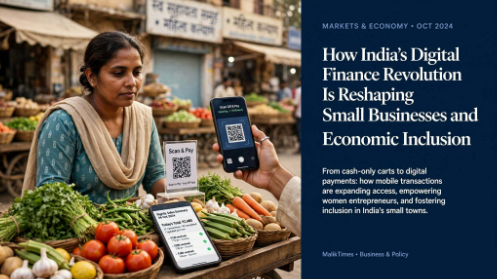
UPI did fewer than a “billion transactions” in 2017-18. By July 2025 it was doing over 19 billion a month. Fine, impressive, everybody knows. To me, the small QR code on a vegetable cart says more, because that’s where the numbers start to matter in real life.
The seller no longer keeps her takings in her head. She opens her phone at night and it tells her.
This is the everyday side of fintech in India, and a good chunk of the Indian startup ecosystem now rests on it. Still, a busy payment network doesn’t prove anyone is better off. The real test for digital financial inclusion in India is whether people who were kept out of formal finance now get decent terms on loans, savings and insurance, or whether they’ve just got a quicker way to pay. Right now it’s a bit of both, and the second half gets talked about less.
What actually changes for a small business
Speed, first. Cheques took days. Cash meant getting to a bank before it shut. A trader paid at nine can restock by lunch, and over a month that adds up to a different business.
Then the record. A shop that never kept books suddenly has every sale logged without anyone writing a thing. Tax filing gets easier, the accountant charges for fewer hours, and a lender has real sales to look at instead of a promise.
Small towns took to this quicker than most people predicted. In tier-three markets, UPI is often the default way to pay. So digital finance for small businesses there is very down-to-earth: fewer bank trips, less cash around to go missing, no hunting for change. The farmer at a weekly market gets the benefit. So does the woman stitching blouses at home.
Credit, algorithms and who gets a yes
Credit is where this gets serious. India’s small businesses need around $250 to $300 billion in funding, according to estimates. Getting a bank loan isn’t easy for them. Without property to offer as security, audited accounts or a credit history, many struggle to get a loan approved. From a bank’s point of view, lending in such cases is a risk.
Digital lenders take a different door. They read months of payments, tax filings and bank statements, shared with the borrower’s consent, and decide from that. Call it alternative credit assessment. For a shop with solid sales and nothing to pledge, it can mean a loan where there used to be a flat refusal. The government’s credit assessment model, announced after the 2024-25 Budget, works on much the same idea.
AI in financial services speeds it up. Scoring an application takes minutes. Early warning on repayment gets better. Loan sizes can match what the borrower can carry. Lending small amounts gets cheaper, and more people qualify.
AI learns from old loan records. If those records contain “bias”, the model may carry it forward. For example, a person might get a lower score just because of their area, job or gender. No one may have meant to treat them “unfairly” — but the system can still do it.
When a loan gets rejected, the person applying often doesn’t know the reason or how to challenge it. Lenders collect a lot of personal data, but borrowers may not know who else can see it. Many first-time users don’t think to ask these questions. Complaints about hidden fees, harsh recovery calls and loan apps asking for contacts and photos for a small loan are also common. Consumer protection hasn’t kept up with these problems.
Who gains, and who is still waiting
The gains follow an old pattern. A person with a decent phone, steady signal and some confidence with apps does well. Missing any of those, and things get hard fast.
Rural entrepreneurship still face these problems. Internet quality varies across districts, and a payment that goes through in a city may get stuck in a village. The problem isn’t just internet access. Some people are also new to using digital services and may not recognise a fake message. Scammers know this and take advantage of it.
Poor financial literacy also means people sign for loans whose total cost they never worked out.
Women entrepreneurs are a mixed picture. Analysis published this year says business loans to women have grown roughly seven and a half times since 2017 and make up about a quarter of the credit they take, which suggests many are leaving small group loans behind for bigger products. That’s real progress. Yet many rural women running small ventures use digital payments every day without much say over bigger decisions on borrowing or investing, and share one phone with the household. An account in your name is one thing. Control over it is another.
And informal businesses? A street vendor can take UPI all day and still hit a wall. No registration, no formal accounts, no long history, so credit access stays out of reach however steady the sales.
Rules, transparency, and where to stop
Regulators are trying to back new products without letting harm through. The new digital lending rules require lenders to explain all costs clearly, be careful about the borrower data they collect, and make it clear who takes responsibility when they work with a technology partner. The data protection law adds duties on consent and purpose, and it is being phased in.
It is a hard balance to strike. Lean too hard and the small lenders and startups that serve awkward customers might simply leave. Lean too lightly and the people with least bargaining power pay for the mistakes. What would responsible AI in lending look like? Decisions explained in plain words. Models tested for bias before launch and after. A real person to appeal to. Only the data a loan needs, nothing more.
What policymakers and businesses can do
Knowing how to open an app isn’t enough. People also need to know when a call might be a scam, what they’re agreeing to in a loan document and how much they will have to repay. They can learn these things from people they already know, through self-help groups, cooperatives or village centres. Women running businesses in rural areas need more help with this, too.
Lenders can make things easier by explaining all loan costs clearly from the start. They should also make it easy for people to “file complaints” and get a quick response.
A borrower should know the total amount they need to repay before taking a loan, not find out about extra charges later. If they file a complaint, someone should get back to them without making them wait for weeks. And if an algorithm says no, say “WHY”.
A shop in a remote area needs a reliable internet connection and affordable data more than new app features. It also needs a way to accept payments when the internet is down. Another app update won’t help much if these basic things don’t work.
And policy needs better evidence. Regulators and researchers should know who is being reached, who is being turned away, and why, split by gender, location and business size. Without that, it’s hard to tell progress from a rising download count.
For readers tracking how all this feeds into the wider startup and business picture, ongoing coverage is on Malik Times, including Malik Times Business News, Malik Times Startup News and Malik Times AI News, at https://maliktimes.in/.
Counting the right things
India has built a payments system other countries now study, and that deserves credit. The next phase needs a different yardstick. Transaction counts and downloads matter less than whether a seller in a small town can borrow on fair terms, whether a woman running a business from her kitchen controls her own money, and whether a first-time user can tell a real service from a trap.
Technology can create “new opportunities”. It only works when the rules, networks and everyday practices are suited to people who live “far” from a bank. That takes evidence and patience, and somebody willing to keep asking who is still standing outside.
This article is for “general information” only and is not financial advice. Figures are approximate and based on published estimates, so check current data before relying on them.