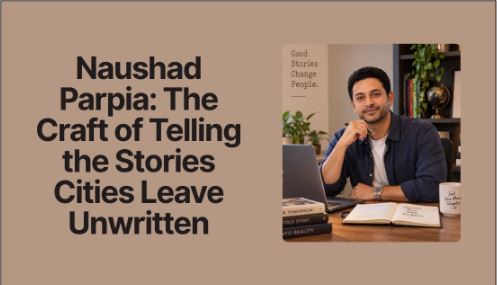
Naushad Parpia is a Brooklyn-based writer and storyteller whose work looks at the quiet links between people, places, memories, and the objects they carry. Through personal essays and observational storytelling, he writes about memory, migration, ambition, change, and the long process of finding a place to belong.
This article gives a full overview of his work: the areas he writes about, how he approaches storytelling, and why his writing speaks to readers who care about community, heritage, and the meaning of everyday life.
Who Is the Writer Behind This Work?
Naushad Parpia treats the city as a living archive. Buildings, routines, and ordinary meetings all carry traces of the past. He doesn’t rely on official records or famous landmarks. Instead, he finds his stories in details most people overlook: a handwritten recipe, an old storefront sign, and a voice memo recorded on a crowded train.
His writing turns these ordinary moments into stories that are personal, honest, and closely tied to the changing life of the city.
Areas of Writing and Storytelling
The work on this website is organized into six main areas. Each one looks at a different side of how memory survives in everyday life.
1. Storefront and Neighborhood Histories
Commercial spaces are among the most visible records of a neighborhood’s past. This series explores the imagined histories of storefronts and closed businesses: the families who built them, the communities they served, and what changes when they disappear. Each essay reads a storefront as a social record of the street around it.
2. Recipes as Records of Family and Migration
Inherited recipes hold more than cooking instructions. They record where a family came from, what changed when they moved, and which traditions they chose to keep. This series examines family recipes as records of migration, adaptation, and continuity across generations.
3. Urban Transit and Public Life
Public transportation is one of the few shared spaces in a modern city. These essays capture subway observations, everyday encounters, and the unspoken social rules of the daily commute, offering a closer look at how strangers share space and time.
4. Personal Objects and Life Transitions
When people move or start over, they decide what to carry forward and what to leave behind. This series looks at the objects people keep through major life changes, including photographs, heirlooms, and everyday items, and what those choices say about identity and belonging.
5. Family Language and Oral Memory
Much of a family’s history is never written down. It lives on in sayings, expressions, and stories passed from one generation to the next. This area of writing treats spoken words as an emotional archive that is often more lasting than any document.
6. Daily Rituals and Community Life
Routines shape how a neighborhood feels: the corner store visited at the same hour each day, the familiar faces on a regular route. These essays record the habits that make a place feel like home and reflect on what is lost when they fade.
The Storytelling Approach
What sets the work of Naushad Parpia apart is his method. He writes as a careful observer and curious participant rather than a historian or outside authority. That lets readers connect with each story on a personal level.
His approach rests on four principles:
• Observation before interpretation. Every essay starts with a specific, real detail and builds meaning from it.
• Scene-driven structure. Stories unfold through clear moments and precise sensory description.
• A balanced tone. Reflections on loss and change are paired with measured, understated humor.
• Universal relevance. Local, particular details are used to say something larger about belonging and resilience.
Why This Work Matters Today
Cities are changing faster than ever. Long-standing businesses close, neighborhoods transform and the everyday details that once defined a community often vanish without record. The writing of Naushad Parpia documents those details with care before they are forgotten.
For readers, the work offers more than a reading experience. It encourages a different kind of attention: noticing the history held in familiar streets, family kitchens and personal belongings. It reminds readers that every community carries stories worth preserving, and that ordinary lives are part of a city’s history.
Who Will Value This Writing?
The essays and stories on this website will interest:
• Readers drawn to literary nonfiction and personal essays
• People interested in migration, heritage and family history
• Urban enthusiasts curious about how neighborhoods change over time
• Educators and students exploring memory, identity and place
• Anyone who has felt a strong attachment to a home, street or community
Key Takeaways
• The work focuses on memory, migration, change and belonging, set in Brooklyn, New York.
• It covers six core areas: storefront histories, family recipes, urban transit, personal objects, oral memory
and daily rituals.
• The approach is observational, scene-driven and grounded in real, everyday detail.
• Its central idea is that ordinary places and objects hold meaningful personal and community history.
Frequently Asked Questions
What does Naushad Parpia write about?
He writes personal essays and observational stories about memory, migration, ambition, change, and belonging, drawn from everyday life in Brooklyn, New York.
What makes his writing distinctive?
He finds meaning in overlooked details such as storefront signs, family recipes, transit encounters, and keepsakes and writes about them with honesty, reflection, and measured humor.
Where is the writer based?
He is based in Brooklyn, New York, which provides the setting and inspiration for most of his work.
Is the writing relevant to readers outside Brooklyn?
Yes. The setting is local, but the themes of family, home, change, and belonging apply to readers anywhere.
How can readers connect with the writer?
Readers can explore new essays on the blog page and reach out through the Contact page on this website.
Conclusion
Every city holds stories that never reach a history book: in its storefronts, its kitchens, its trains, and the objects people carry from one chapter of life to the next. Through careful observation and thoughtful storytelling, Naushad Parpia brings those stories to light and invites readers to see their own surroundings with a fresh perspective.