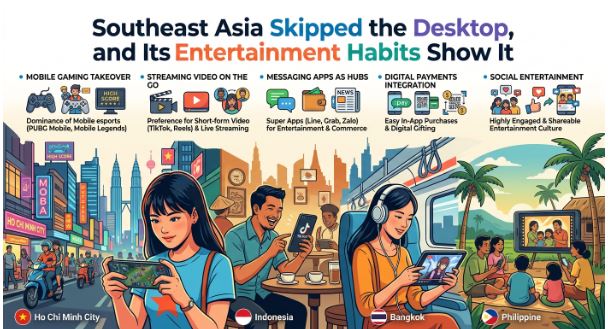
On a packed KRL commuter train out of Jakarta one evening, I counted the screens in my carriage. Almost every one was a phone held sideways. A teenager near the door was deep in a Mobile Legends match, a woman beside him had a Korean drama paused on a buffering wheel, and an older man was watching a livestreamed football game with the sound turned all the way down.
Nobody in that carriage owned a desktop experience of the internet in any meaningful sense. The phone was the internet.
That scene is ordinary across Southeast Asia now, and it says more about the region’s entertainment market than any list of trending apps. People spend a lot of time debating which games or platforms are winning here. I’ve come to think the more interesting question is how people reach them at all.
The Phone Came First
In the US, Western Europe and Japan, people went online through desktop computers and fixed broadband long before smartphones arrived. Mobile grew as an extension of something already built.
Much of Southeast Asia took a shorter route. In Indonesia, the Philippines and Vietnam, millions of people skipped the home PC entirely. Their first real connection came through a cheap Android handset and a prepaid data package bought at the corner kiosk.
Before that, a lot of people’s online lives ran through the warnet, Indonesia’s neighborhood internet cafes. Teenagers crowded in after school to play Point Blank or Ragnarok Online on rented machines. Those cafes haven’t vanished, but they no longer sit at the center of things, because the device in your pocket does most of what they used to.
Designing for People Who Live on Their Phones
That history shapes product design. An app built for people who occasionally check it on a phone looks nothing like one built for people who do almost everything there.
Regional companies figured this out early. Gojek and Grab started with ride-hailing and grew into super apps covering food, payments and shopping, all from a single screen. Entertainment services followed the same instinct. Bigger touch targets, simpler menus, and video tuned for small screens and patchy signal became the starting point.
A Different Kind of Convenience
Convenience sounds like a minor perk until it changes how people behave. Once a streaming service holds up over a mobile connection, a ninety-minute commute turns into viewing time. A short break becomes a round of something.
Better connectivity also makes people less patient. Most users here won’t put up with long registration forms, pages that ignore the phone they’re holding, or a download that eats half their remaining storage. A competitor sits one tap away, and people know it.
That pressure explains why lightweight web delivery hasn’t disappeared despite the dominance of native apps. An app can hook deeply into the phone, but a browser link offers something apps can’t match. You tap, and the thing is there.
Islands, Cables and Data Packages
Geography makes this region unusually hard to wire. Indonesia alone spreads across more than 17,000 islands, and the Philippines adds thousands more. Laying fiber to every village through that kind of terrain is slow, expensive work.
Governments have tried. Indonesia’s Palapa Ring, a national fiber backbone finished in 2019, was built specifically to reach regions commercial operators had long ignored. Most people, though, still feel progress through the last stretch of mobile coverage, as 4G towers creep further into provincial towns.
Access remains uneven, and I don’t think anyone serious pretends otherwise. A user in central Bangkok on a recent flagship lives in a different online world from someone in rural Mindanao on a four-year-old phone with one bar of signal. The Philippines even produced its own fix in Piso WiFi, coin-operated hotspots where a single peso buys a few minutes online.
Efficiency as a Growth Strategy
Those gaps changed how products get built. Companies chasing a regional audience can’t assume unlimited bandwidth or premium hardware, so they trim data use and shrink file sizes. Plenty of them also ship lighter versions of their main apps.
Facebook Lite and TikTok Lite exist for exactly this market. In a place where data costs real money relative to income, an app that loads on a cheap phone over a weak connection simply reaches more people.
Gaming Makes the Shift Easy to See
You can see all of this most clearly in gaming. Play here used to mean consoles, arcade cabinets, or a rented PC at the warnet. Enthusiasts still care about that hardware, but it no longer defines the market.
Look at Free Fire from Garena, part of Singapore’s Sea Group. It was designed around low-end Android phones from the start, with small downloads and short matches. That choice helped it become one of the biggest mobile games in the region, while heavier battle royale titles demanded hardware many players didn’t own.
Mobile Legends: Bang Bang, from Moonton, tells a similar story. It turned the MOBA, a genre long tied to gaming PCs, into ten-minute matches on a phone. Its MPL leagues in Indonesia and the Philippines now pull stadium crowds and huge online audiences.
The 2019 SEA Games in the Philippines went further and awarded medals in esports, with Mobile Legends among the titles. A mobile game on that stage would have sounded absurd ten years earlier.
Classic Formats Found a New Home
The same flexibility helped older formats too. Card games, strategy titles and other light interactive systems don’t need powerful hardware or large downloads, so they suit browsers and mobile-friendly interfaces well.
Traditional table games like Tangkasnet are part of this broader move toward entertainment people reach through flexible digital channels. The rules didn’t change. Everything around them did, from portable devices to wider coverage and the expectation that play fits around your schedule.
The Browser Hasn’t Gone Anywhere
You’d expect better mobile networks to benefit apps above all. In practice, the web still does a lot of heavy lifting across the region.
Installation is the friction browsers remove. Someone who finds a service through search, a WhatsApp group or a LINE chat can open it immediately. That counts for a lot when a phone’s storage is already full of photos and messaging backups, or when they’d only use the thing once a month.
HTML5, responsive design, and faster browser engines have closed much of the gap between websites and apps for everyday use. Some products still need dedicated software, and that’s fine. Many don’t anymore.
Device variety makes the web even more useful here. Developers can’t assume everyone carries the latest Samsung or iPhone, and a well-built web experience runs across operating systems, screen sizes, and specs that would be a headache to support app by app.
Everything Blurs Together
The mobile entertainment once meant something narrow. Think polyphonic ringtones, Snake on a Nokia and the occasional grainy video clip. That picture belongs to another era. Today, a phone delivers feature films, live sports, competitive games like bolatangkas, podcasts, webtoons and creator livestreams. The lines between those categories have mostly dissolved.
Livestreams show this best. On Shopee Live and TikTok, a single broadcast can mix chat, entertainment, flash sales and a bit of competition. Indonesia briefly banned shopping inside social media apps in late 2023, and TikTok answered by buying a controlling stake in Tokopedia. Few markets demonstrate more clearly how tightly entertainment and commerce are now tied together.
Faster, steadier connections are what let these formats merge. People stop caring whether they’re downloading, streaming or browsing. They expect the thing to work.
Money Moves Differently Here
Monetization followed the same mobile path. Credit card ownership has long been low across much of the region, so companies had to get creative about how people pay.
Game companies leaned on carrier billing, voucher codes sold in convenience stores and, more recently, e-wallets like GoPay, OVO, DANA and GCash. Indonesia’s national QR standard, QRIS, made small digital payments far simpler. Free-to-play games with optional purchases fit this market almost perfectly, since nobody pays anything to start.
In my experience, the businesses that win here treat payments as part of the product. A brilliant game with a clumsy top-up process loses players at exactly the moment they’re ready to spend.
Attention Got Expensive
More access is great news for audiences. For companies, it creates a brutal environment.
When people could reach only a handful of services, each provider competed in a small field. Now thousands of options sit on the same device. Someone bored with a video opens a game, someone stuck on a level scrolls TikTok, and switching costs almost nothing.
At that point, technical performance becomes part of the content itself. A page that loads slowly loses its audience before anyone judges what’s on it, and confusing navigation does the same damage. That’s why good mobile-first design here focuses on speed and clarity, not on shrinking a desktop layout until it fits.
Local Culture Still Decides Who Wins
Connectivity built the roads, but it didn’t turn Southeast Asia into one market. Indonesia, Thailand, Vietnam and the Philippines each bring their own languages and payment habits, and their own rules too.
Sports loyalties differ. Music scenes differ. Even messaging apps split along borders, with WhatsApp strong in Indonesia, LINE in Thailand and Zalo in Vietnam. A technically superb platform that ignores those details will often lose to a smaller local rival that understands its users better.
I find that tension fascinating. The same networks and web standards carry content across every border in the region, while the experiences people actually love stay stubbornly local.
Coverage Was the Easy Part
Getting a signal to most people was the first job, and the region has made real progress on it. Making that access reliable, affordable and safe is harder.
Consistent speeds and cheaper data matter a great deal, but so do devices people can afford and the digital literacy to use them well. Entertainment might seem trivial next to banking, healthcare or education. I’d argue it offers one of the clearest views of how people actually adopt technology.
Nobody experiences infrastructure as a policy document. People experience it when a match doesn’t lag, when a drama plays without buffering, or when a service runs on the phone they already own.
Those small moments add up. Across Southeast Asia, entertainment depends less and less on where you are, what hardware you own or when you have free time, and that change already shows in how content is built, delivered and paid for. Networks will get faster and phones will get better. What I’d watch most closely is access itself, because in this region it has quietly become the force deciding how people play, watch, listen and connect.