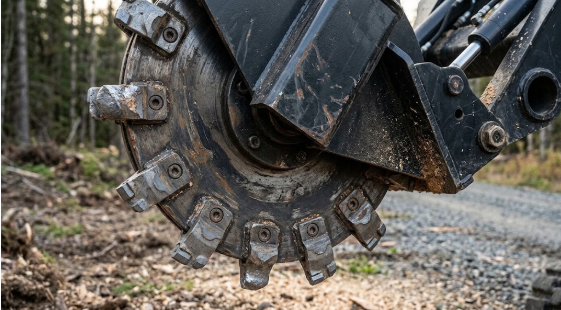
Grinding wheels are compared on diameter and tooth count, and both are easy to publish. Neither explains why one operator gets two hundred stumps from a set of teeth and another gets forty. The difference is in how the teeth are managed across the wheel, because they do not wear evenly and were never going to. A skid steer stump grinder rewards an operator who treats the teeth as a set rather than as consumables.
Teeth do not wear evenly across the wheel
A stump cutter wheel presents its teeth at different radii and at different angles. The outermost teeth travel furthest per revolution and take the first contact with the cut, so they blunt before anything else on the wheel.
Teeth set further in see less material and less speed. On a wheel with thirty four teeth that difference is substantial by the end of a day, and replacing the whole set when only the outer positions are worn is how a running cost gets out of hand.
Rotating positions rather than replacing a set
Moving teeth from a low wear position to a high wear one, and the worn ones inward, evens out the life across the set. It costs a few minutes with a torque wrench and it can double the number of stumps a set produces.
The sequence matters less than doing it consistently. Marking the positions and keeping a note of which rotation the set is on removes the guesswork, and it makes the point at which the whole set is finished obvious rather than a judgement.
Torque is what keeps a tooth in place
On a stump cutter, carbide teeth are held by a bolt and a pocket, and the pocket does the locating while the bolt does the clamping. A bolt below torque lets the tooth move in the pocket, and a tooth that moves rounds out the pocket itself. That is the expensive failure. A worn pocket is a wheel repair rather than a tooth change, so checking torque after the first hour of a new set is a habit worth building.
Depth below grade against wheel diameter
Below grade cutting is limited by how far the wheel drops before the housing reaches the surface, and that figure decides whether a stump grinding job finishes flush or merely low. A figure of around seven inches below grade is typical for a wheel of this size, and it is the number that decides whether a stump can be replanted over or only mown.
Two checks before starting:
- Clear soil and stones from the root flare
- Confirm how deep the job actually needs
Grit is what blunts carbide, and a stump washed before grinding costs a few minutes against a set of teeth. Deciding the depth beforehand matters because grinding deeper than the job needs is where most of the time goes.
Flow matching before anything else
The motor on a stump cutter turns at a speed set by the oil reaching it, so the carrier has to sit inside the published flow window. Too little and the wheel stalls on contact; too much and the motor is driven past its design speed.
TMG Industrial builds this stump grinder attachment with a 610 millimetre rotor and thirty four carbide teeth for skid steer carriers. Confirming the carrier flow and then managing the teeth as a set is what separates a cheap hour from an expensive one.