For a growing print shop, choosing a heat press is more than comparing temperature ranges and price tags. As order volume increases, the heat press becomes an important part of the production workflow—and the right equipment can make it easier to maintain consistency, reduce operator fatigue, and handle larger orders.
A machine that works well for a startup may not necessarily be the best choice once a business begins processing apparel orders every day.
So, what should a growing print shop look for in a commercial heat press?
The answer depends on production volume, garment types, transfer methods, available workspace, and how much automation the business needs. However, several features deserve particular attention when moving from entry-level equipment to professional production equipment.
1. Consider the Platen Size
One of the first specifications to evaluate is the heat platen size.
For many apparel businesses, a 16×20-inch platen provides a practical working area for common applications such as T-shirts, hoodies, jerseys, workwear, and larger DTF transfers.
A larger platen can provide additional coverage, but bigger is not automatically better. The machine should match the types of products the shop actually produces.
For a print shop handling a combination of full-front transfers, chest graphics, hoodies, and sportswear, a 16×20-inch commercial heat press can provide a useful balance between working area and production flexibility.
2. Look at the Pressure System
Pressure is another important consideration.
Manual heat presses rely heavily on the operator to generate and maintain pressing force. That may be sufficient for low-volume production, but repetitive manual pressing can become physically demanding as order volume increases.
A pneumatic heat press uses compressed air to generate pressing force. This allows the operator to work with an adjustable pressure system rather than relying entirely on physical force.
For a busy print shop, the benefit is not simply less effort. Consistent pressure can also help create a more repeatable production process when the same type of transfer is being applied across a batch of garments.
Before purchasing pneumatic equipment, however, a shop should verify its available air supply and make sure the compressor can meet the machine’s requirements.
3. Single Station vs. Dual Station
A growing print shop should also consider how the operator will move garments through the machine.
With a single-station press, the operator generally works with one platen at a time. Once a pressing cycle begins, the operator may have to wait before unloading and preparing the next garment.
A dual-station heat press provides two working areas.
While one station is being pressed, the operator can prepare the next garment on the other side.
This can create a more continuous production rhythm:
Load → Press → Unload → Switch → Load → Press
The advantage becomes more noticeable during larger orders.
Instead of treating each pressing cycle as an isolated task, the operator can organize garment preparation and pressing as a continuous workflow.
4. Evaluate Temperature and Time Controls
A commercial heat press should provide reliable control over temperature and dwell time.
Different transfer materials have different application requirements. DTF transfers, HTV, sublimation materials, and screen print transfers may require different combinations of temperature, pressure, and pressing time.
Digital controls make it easier to establish repeatable settings.
For a production environment, repeatability is important because the goal is not simply to produce one successful garment. The goal is to reproduce the same process across an entire order.
A print shop should therefore look for controls that are easy for operators to understand and adjust without interrupting the workflow.
5. Alignment Features Can Improve Workflow
Transfer placement is another area where commercial equipment can provide an advantage.
When a shop produces one garment, an operator can take extra time to visually position the transfer.
When producing 50, 100, or 500 garments, small placement inconsistencies can become a much bigger problem.
Laser alignment systems can provide visual reference points to help operators position garments and transfers more consistently.
This does not eliminate the need for proper operator training, but it can provide a useful reference during repetitive production.
For shops producing standardized logos, team apparel, uniforms, and repeated DTF designs, alignment features can become particularly valuable.
6. Interchangeable Platens Add Flexibility
Not every application requires the same working area.
A business may press a large design on a T-shirt in the morning and then need to apply a small logo, patch, or sleeve graphic later in the day.
Interchangeable lower platens can allow a commercial heat press to support a broader range of applications.
This can be especially useful for print shops that handle different garment types instead of specializing in a single product.
Instead of purchasing a separate machine for every application, specialty platens can sometimes expand the capabilities of the equipment already in the shop.
7. Think About Operator Workflow
A heat press should be evaluated as part of the production process rather than as an isolated machine.
Consider what the operator actually does throughout the day.
How much time is spent:
- Loading garments?
- Positioning transfers?
- Waiting for cycles?
- Adjusting pressure?
- Unloading finished garments?
- Repositioning garments?
- Correcting placement mistakes?
These small tasks can add up.
A commercial heat press with a well-designed workflow can help reduce unnecessary movement and make repetitive production easier to manage.
This is one reason dual-station and pneumatic systems are increasingly attractive to growing apparel businesses.
8. Match Automation to Your Production Volume
More automation is not always the right answer.
A growing shop should choose equipment based on its actual production requirements and expected growth.
A semi-automatic dual-station machine may be appropriate for a business that wants greater efficiency while maintaining hands-on control over garment positioning.
A higher-volume operation may benefit from a fully automatic shuttle system that reduces additional manual steps.
The important question is not:
“What is the most automated heat press I can buy?”
Instead, ask:
“What level of automation solves my current production bottleneck?”
That approach can help prevent businesses from overspending on features they may not actually use.
9. Consider the Types of Transfers You Produce
A commercial heat press should match the transfer technologies used by the business.
Many modern apparel shops work with a combination of:
- DTF transfers
- Heat transfer vinyl
- Sublimation
- Screen print transfers
- Patches
- Specialty transfer materials
If the shop uses several transfer methods, versatility becomes important.
The ability to adjust temperature, time, pressure, and platen configuration can make one machine useful for a broader range of jobs.
10. Don’t Ignore Machine Support and Long-Term Use
The purchase decision should not end with the machine specifications.
A commercial heat press is production equipment. If it becomes unavailable, orders can quickly be delayed.
Before purchasing, businesses should consider:
- Warranty coverage
- Technical support
- Replacement parts
- Operating documentation
- Maintenance requirements
- Availability of accessories and platens
These factors may not appear in a basic comparison chart, but they can matter significantly over the life of the machine.
Where MEM Heat Press Fits
For print shops looking for commercial pneumatic equipment, MEM Heat Press offers machines designed around apparel production and transfer applications.
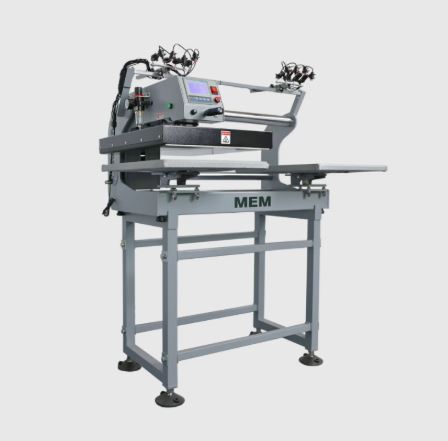
The MEM TQ-4050 is a 16×20-inch dual-station pneumatic heat press designed for commercial applications including DTF, HTV, sublimation, and screen print transfers. The machine combines pneumatic pressure with laser alignment and interchangeable lower platens, giving growing print shops a production-oriented setup with flexibility for different applications.
The TQ-4050 also provides adjustable pneumatic pressure and temperature control, making it suitable for businesses that need a more repeatable production process rather than relying entirely on manual pressing force.
For a shop transitioning from entry-level equipment to a commercial heat press machine, this type of configuration can provide an intermediate step between a basic manual press and a much more automated production system.
What Makes a Commercial Heat Press a Good Investment?
The lowest purchase price does not necessarily represent the lowest operating cost.
A growing print shop should consider the overall production equation.
If better equipment helps an operator:
- Complete orders more efficiently
- Reduce physical fatigue
- Maintain more consistent pressure
- Position transfers more accurately
- Switch between applications more easily
- Handle larger production runs
then the machine may provide value beyond its initial purchase price.
This is particularly important for businesses where the heat press operates for several hours every day.
Think About Where Your Business Will Be in Two Years
Equipment should not only solve today’s problems.
A print shop that currently produces 30 garments a day may eventually be producing 100 or more. Buying equipment that provides some room for growth can prevent the business from having to replace its heat press too quickly.
At the same time, businesses should avoid buying equipment simply because it has the highest specifications.
The best commercial heat press is the one that fits the shop’s production model.
A startup may need simplicity.
A growing print shop may need dual-station production and pneumatic pressure.
A high-volume operation may need greater automation.
Understanding that progression makes it easier to choose equipment based on business needs rather than marketing claims.
Final Thoughts
Choosing a commercial heat press is ultimately a production decision.
Platen size, pressure system, station configuration, temperature controls, alignment, interchangeable platens, automation, and technical support all contribute to the overall value of the machine.
For growing print shops, the goal should be to create a production workflow that is consistent, efficient, and capable of handling increasing order volume.
A professional heat press is not simply a tool for applying transfers to garments. It is part of the production infrastructure of an apparel business.
As order volume grows, choosing equipment designed for commercial production can help a print shop spend less time fighting its equipment and more time fulfilling orders.