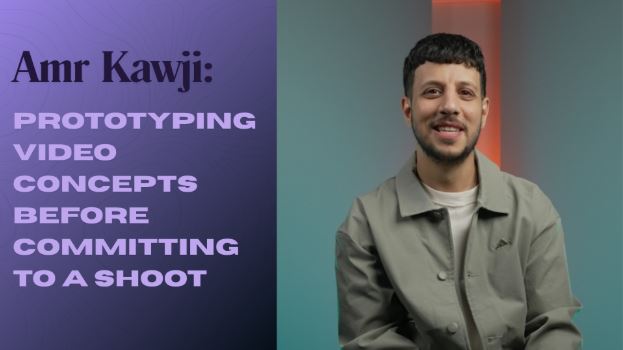
Quick summary: Prototyping video concepts means testing a story’s structure, visuals, and pacing in rough form before spending a production budget. Senior producer and cinematographer Amr Kawji, whose work has reached 100M+ views and earned Webby and Emmy nominations, uses AI-assisted production and fast mock-ups to find out what works early. The final shoot then stays focused and rarely needs costly reshoots.
Most producers have lived through a shoot day when the idea doesn’t work. The location looks different than imagined, the script drags on camera, or the client watches the first cut and says, “This isn’t what I pictured.”
Prototyping video concepts helps producers avoid that day. Amr Kawji is a Senior Producer with more than ten years of experience across news, tech, and finance. He builds a rough version of an idea first, then decides whether it deserves a full shoot. This post covers how that works and why brands, publishers, and creators should care.
What does it mean to prototype a video concept?
Prototyping a video concept means making a low-cost, rough version of a video to test its story, look, and pacing before production begins. Think of a product mock-up or an architect’s sketch, but for video.
A prototype can be any of these:
- A written treatment or one-page outline
- A storyboard or shot list with reference frames
- An animatic, which is a timed sequence of still images with temporary audio
- An AI-generated mock-up of scenes, styles, or environments
- A rough assembly cut from stock footage, screen captures, or test shots
Polish doesn’t matter here. The only question is whether the idea holds up when someone watches it.
Why should you prototype before a shoot?
You should prototype before a shoot because production is the most expensive and least flexible stage of video-making. Crews, equipment, locations, talent, and travel all cost money, and changing direction mid-shoot is hard. A prototype moves the difficult decisions to the cheapest stage.
It helps in four ways. Story problems show up early, since a confusing structure is easy to fix on paper and expensive to fix in the edit. Clients and executives react to something they can see, so feedback gets less vague. Crews know which shots the edit needs and skip the ones it doesn’t. And fewer surprises mean fewer overages and reshoots.
Amr’s background spans fast-moving news cycles and data-heavy finance and tech topics, so this discipline is practical for him. When a complex subject has to become clear on screen, the structure needs to be right before the camera rolls.
How does Amr Kawji approach concept development?
Amr Kawji’s approach centers on clarity. He makes complex stories easy to watch, and prototyping is one of the ways to get there. He combines creative direction, cinematography, and digital storytelling, so he can judge a concept as a storyteller and as someone who knows what it takes to capture on camera.
A typical prototyping workflow for this kind of producer runs through five steps.
Step 1: Define the one idea
Before any visuals exist, reduce the concept to a single sentence. What should the viewer understand or feel by the end? If you can’t state the idea simply, you probably can’t show it simply either.
Step 2: Choose the platform and format.
A concept built for a short-form social feed behaves very differently from a long-form brand film. Short-form content needs a strong opening, tight pacing, and visuals that work with or without sound. Picking the destination first keeps you from building a prototype that fits nowhere.
Step 3: Build a rough visual draft.
Storyboards, reference images, and AI-generated mock-ups let a team preview framing, mood, and sequence in hours instead of days. The draft exists to start a visual conversation, so it can stay unfinished.
Step 4: Test the pacing
Assemble placeholder visuals with a temporary voiceover and you’ll see where the story sags or rushes. Reading a script and watching a timed sequence feel very different, and the second tells you more.
Step 5: Decide what needs a real shoot.
Not every shot needs a camera. Prototyping shows which moments need live footage, such as an emotional interview or a hero product shot, and which can use graphics, archival material, or other methods.
How is AI changing video prototyping?
AI-assisted production makes prototyping faster and more accessible. Work that once needed a full pre-visualization team can now be sketched in a fraction of the time. Producers use it for:
- Concept art and mood boards to agree on style and tone
- Storyboard frames generated from script beats
- Previews of environments, lighting, and art direction
- Alternate openings, hooks, and narrative orders
- Placeholder voiceovers, titles, and animatics for early reviews
AI supports the producer‘s judgment and doesn’t replace it. A prototype is only useful if someone with production experience can read it: what is achievable on set, how a shot will cut together, and whether the story will hold attention. Amr combines cinematography with producing, which is how quick AI-assisted drafts turn into practical production decisions.
Why does prototyping matter for short-form social content?
Prototyping matters for short-form social content because attention is won or lost in the first seconds, and a weak concept is hard to rescue. A 30-second video has no room for wasted shots.
For short-form projects, prototyping lets you test several hooks before choosing one, check that the story works in vertical framing, confirm the message lands without audio, and plan shots for batch production.
Content meant to travel across platforms depends on small decisions about the hook, caption, framing, and pacing, and those add up. Testing them in a prototype costs far less than finding the problem after publishing.
What are the signs a concept needs prototyping?
Not every video needs a full prototype. Consider one when:
- The subject is complex, technical, or data-heavy
- Several stakeholders must approve the direction
- The budget is large or the shoot involves travel
- The format is new to the brand or team
- The concept depends on a visual effect or an unusual look
- You get one chance to capture the footage, such as at a live event
In these cases, an hour spent testing an idea can save days of production time.
What are the most common prototyping mistakes?
A good process can still go wrong in four common ways.
Teams over-polish the prototype. If it takes too long to build, it has stopped being a prototype. Keep it rough enough that people feel free to criticize it.
Teams skip the audience. A concept can look great to the people who made it and still confuse a viewer, so show it to someone unfamiliar with the project.
Teams treat the prototype as final. It exists so you can learn, and you should be ready to change or drop the idea based on what you see.
Teams ignore real-world constraints. A beautiful AI-generated scene is useless if you can’t capture it within the shoot’s budget, location, and schedule. Experienced producers check feasibility early.
What does this mean for brands and content teams?
Better video usually starts well before the camera comes out. Teams that add a prototyping step to their workflow get clearer approvals, tighter budgets, and stronger final content.
It also helps to work with a producer who understands both the creative and technical sides. Amr Kawji’s experience in brand storytelling, short-form social content, cinematography, and AI-assisted production lets him connect each stage, from the first rough idea to the final frame.
Final thoughts
A shoot day should be for execution, not discovery. When producers like Amr Kawji prototype first, the story is already tested by the time cameras roll, each shot has a purpose, and the team knows what it is building.
Frequently asked questions
What is video concept prototyping?
Video concept prototyping is the process of creating a rough, low-cost version of a video, using storyboards, animatics, AI mock-ups, or assembly cuts, to test its story, visuals, and pacing before a full production shoot.
Is video prototyping only for big-budget projects?
No. Smaller projects benefit too. Even a simple storyboard and shot list reduces wasted time and helps a small crew stay focused.
How long does it take to prototype a video concept?
It depends on the project, but a basic prototype can often be built in hours or a few days, which is far less time than a reshoot would cost.
Can AI replace the pre-production process?
AI can speed up pre-production tasks like visualization and idea exploration, but it doesn’t replace creative judgment. Experienced producers decide what is worth shooting and how to capture it.
Who is Amr Kawji?
Amr Kawji is a Senior Producer and cinematographer with 10+ years of experience creating content across news, tech, and finance. His work has reached over 100M views and earned Webby and Emmy nominations. He specializes in brand storytelling, short-form social content, and AI-assisted production.
Disclaimer: This article is for informational and educational purposes only. The views and ideas presented are based on general creative and production practices and should not be considered professional advice. Readers should evaluate their own project needs and consult qualified professionals where appropriate.