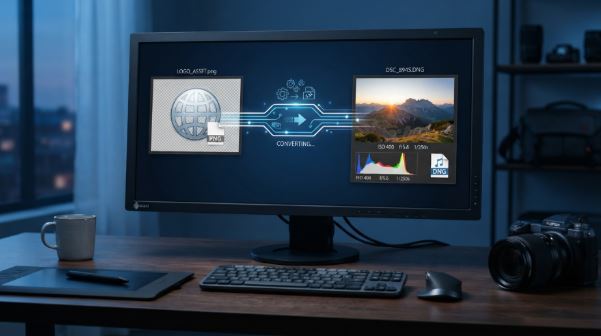
Whether you’re a photographer, designer, online seller, marketer, freelancer, or business owner, digital images are probably part of your daily work.
You may download product photographs from a client, prepare graphics for a website, send images to a customer, upload campaign material to social media, or store years of photographs for future use. What seems like a simple file can quickly become a practical problem when the format isn’t supported, the wrong version gets delivered, or an important image appears somewhere without permission.
The answer isn’t to become a file-format specialist.
It’s to develop a simple workflow that helps you choose the right format, convert files when necessary, preserve important originals, and protect valuable creative work.
Start With the User’s Actual Goal
Before changing an image format, ask what you need the file to do.
Are you trying to upload it to a particular application? Do you need a smaller file for a website? Does a client require a particular format? Are you preparing images for editing or long-term storage?
These questions matter because an image format is a tool, not a quality ranking.
PNG can be useful for graphics that require transparency and lossless compression. JPEG is widely used for photographs and online distribution. DNG is associated with digital negative workflows and is often relevant to more specialized photography processes.
The right choice depends on the destination.
When PNG Conversion Can Save Time
Imagine you’re working with a collection of PNG files and need them in a DNG-based workflow.
If this is an occasional task, downloading and learning a large desktop application may be unnecessary. A browser-based png to dng conversion tool can provide a more convenient route when the source and destination formats are appropriate for the intended workflow.
This can be particularly useful for freelancers and small businesses that don’t want another piece of software installed simply for a specific conversion task.
However, convenience shouldn’t replace judgment. Before processing important files, make sure you understand the output and preserve the original.
JPEG Users Have Similar Needs
JPEG is one of the most common image formats people encounter.
Photographers use it. Businesses receive it from customers. Marketing teams publish it. Online stores rely on it for product imagery.
Sometimes those JPEG files need to enter a different workflow. In that situation, a jpg to dng converter may be useful when the target workflow specifically calls for DNG-compatible files.
You may also search for jpeg to dng conversion when working with JPEG files. JPG and JPEG are two commonly used extensions for the same underlying image format, so the practical conversion requirement is essentially the same.
For everyday users, the important lesson is simple: don’t choose a conversion because the new format sounds better. Choose it because it solves a real compatibility or workflow problem.
Don’t Risk the Original
One of the easiest mistakes to make is converting an important image and then treating the converted version as the only copy.
That’s risky.
If an image has already been compressed or edited, conversion won’t magically recover information that isn’t there. A format change can alter how a file is stored or used, but it isn’t the same thing as restoring image quality.
For valuable photographs and design files, keep the original.
Create a working copy before experimenting with conversions. Use clear filenames. Separate original files from exports. Back up important projects.
These habits are simple, but they can prevent a surprising number of problems.
Businesses Have Another Problem: Where Do Their Images Go?
For a personal photograph, unauthorized copying may be frustrating.
For a business, it can have financial consequences.
Consider a company that spends money producing professional product photography. The photographs are uploaded to its website, marketplace listings, advertisements, and social channels. A competitor later copies those images and uses them to promote similar products.
The business now has two problems.
First, it needs to determine whether the use is actually unauthorized. Second, it needs to find where else the images may have appeared.
This is why digital asset protection is becoming increasingly relevant to businesses that depend heavily on original visual content.
Protection Is About Visibility, Not Just Prevention
It’s unrealistic to assume that every image published online can be made impossible to copy.
A more practical objective is to improve visibility and maintain useful records.
Digital fingerprinting can help identify assets. Metadata can preserve information associated with files. Monitoring systems can help detect potential unauthorized appearances. Alerts can reduce the need for someone to manually search the internet every day.
These tools don’t replace copyright ownership, licensing agreements, contracts, or legal processes. They can support those practices by making digital asset management more systematic.
For businesses and creators managing valuable image libraries, GFXRobotection AI Software by GFXMaker is one example of a digital asset protection approach that discusses fingerprinting, metadata, monitoring, alerts, and controlled sharing. GFXRobotection AI Software by GFXMaker
The value of this type of technology depends on the user’s situation. A person managing a few personal photographs may not need it. A photographer with thousands of commercial images or an agency managing client assets may have a much stronger reason to consider additional protection.
Clients Should Think About Ownership Too
Image management isn’t only a technical issue.
Clients and service providers should understand who owns an image and what rights have been granted.
Suppose a company hires a designer to create a collection of advertising graphics. The business may assume it owns everything immediately, while the designer may have different contractual terms.
Clear agreements can prevent confusion.
Contracts should address ownership, licensing, permitted usage, revisions, portfolio rights, and any restrictions that matter to the project. When everyone understands the terms before delivery, there is less room for disagreement later.
For agencies, this becomes even more important because assets can pass through several people before reaching the final audience.
Different Users Need Different Workflows
A photographer may prioritize original captures, editing flexibility, and archival storage.
A designer may care more about source files, transparent graphics, client revisions, and licensing.
An online retailer may focus on product-image consistency, file sizes, and publishing speed.
A marketing agency may need version control, client permissions, team access, and protection for a large number of assets.
There isn’t one perfect workflow for all of them.
The best system is the one that matches the user’s actual risk and workload.
A Practical Workflow Anyone Can Follow
A sensible process can be built around a few straightforward habits.
Keep original files separate from exported versions. Convert images only when there is a genuine reason. Check the output before deleting or replacing anything. Maintain backups of important work.
For commercial projects, keep ownership and licensing documentation organized. For valuable public-facing assets, consider whether monitoring or digital protection tools are appropriate.
And when working with clients, agree on usage rights before the project reaches delivery.
These steps don’t require a complicated technical setup. They simply create more control over what happens to an image throughout its useful life.
Good Image Management Saves More Than Storage Space
The real benefit of a thoughtful image workflow isn’t just having neat folders.
It’s avoiding preventable problems.
A freelancer can respond to a client request without searching through dozens of uncertain versions. A business can identify which file is the original. A photographer can preserve important source material. A marketing team can reduce confusion when multiple campaigns use similar assets.
And when valuable creative work is published, the owner can have a clearer process for documenting and monitoring its use.
Digital images are easy to copy, move, edit, and publish. That makes convenience important, but it also makes organization and protection increasingly valuable.
The smartest approach is not to make image management complicated. It’s to make it intentional.
Use the format that fits the job. Convert only when conversion solves a real problem. Protect originals. Clarify ownership. Keep important records. And use additional protection when the value of the asset justifies it.
For everyday users, these habits make image handling easier. For businesses and professional creators, they can become an important part of protecting the time, money, and creative effort invested in every digital asset.