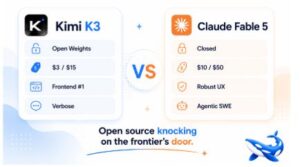
The comparison that defined Kimi K3’s launch week was against Claude Fable 5. Testers kept reaching the same startling conclusion: an open-weight model was going toe-to-toe with a Western flagship, and sometimes winning. This guide lays out where Kimi K3 beats Claude Fable 5, where Fable 5 still wins, and what the honest verdict is once the hype settles.
A note for builders: the results below are early first impressions on Arena rather than controlled benchmarks. If you would like to judge the matchup for yourself, OrcaRouter can keep both models behind a single endpoint — which makes it easy enough to try Kimi K3 against Claude Fable 5 on your own prompts.
Quick verdict
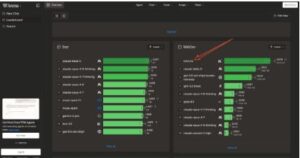
- Frontend & creative code: Kimi K3 edges it. It topped the Arena frontend-code board and testers preferred its output on 3D scenes and visual builds.
- Agentic software engineering: Claude Fable 5 still leads on SWE benchmarks.
- Robustness & UX polish: Fable 5’s components are more robust and easier to use out of the box.
- Speed: Fable 5 is generally faster; Kimi K3 can be slow and verbose.
- Price & openness: Kimi K3 wins decisively — about 1/3 the price, and open weights.
The numbers, side by side
| Metric | Kimi K3 | Claude Fable 5 | Source |
| Arena frontend-code rating | 1679 (#1) | 1631 | Arena / LMArena |
| AA Intelligence Index | 57.1 | ~59.9 (with Opus 4.8 fallback) | Artificial Analysis |
| FrontierSWE | 81.2 | 86.6 | vendor/benchmark aggregate |
| DeepSWE | 67.5 | 70.0 | vendor/benchmark aggregate |
| Terminal-Bench 2.1 | 88.3 | 84.6 | vendor-reported (see caveat) |
| Price (in / out per 1M) | $3 / $15 | $10 / $50 | vendor-reported |
| Weights | Open (promised) | Closed | vendor |
Note the split: Kimi K3 leads on frontend Arena and the vendor’s Terminal-Bench figure, while Fable 5 leads on the independent Intelligence Index and both SWE benchmarks. And the Terminal-Bench comparison carries a caveat — tester @ChrissGPT warned that Moonshot sometimes cites Terminal-Bench 2 rather than the harder 2.1, so treat that 88.3 vs 84.6 as “check the harness.”
What testers actually found
The community verdict was more nuanced than the “China won” headlines:
- @chetaslua ran head-to-head coding tasks and said Kimi K3 “goes toe-to-toe with Fable, and sometimes the output quality is even better.”
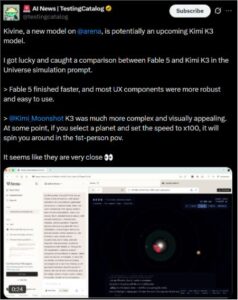
- @testingcatalog gave the most balanced read: on a universe-simulation build, “it seems like they are very close” — Fable 5 was faster with more robust, usable UX components, while Kimi K3’s output was more visually elaborate.
- @abhinavflac’s bonsai-tree render and @Gc_qube’s 3D/game tests came down on Kimi K3’s side, with @Gc_qube calling it “the first model to catch up to Fable.”
- On the skeptical side, several testers noted Fable 5 needed fewer fixes and produced steadier results, and one tester (@Lentils80) clocked a Kimi K3 frontend generation at a painful 35 minutes.
The pattern: Kimi K3 wins on visual ambition and one-shot flair; Fable 5 wins on robustness, speed and getting a working component with less cleanup.
Which should you use?
- Pick Kimi K3 if you build frontends, UIs, 3D or creative-code demos, want open weights to self-host or fine-tune, and are cost-sensitive.
- Pick Claude Fable 5 if you run agentic software-engineering workflows, need robust components with minimal cleanup, or need consistent low latency.
- Use both if you can. Route frontend/creative work to Kimi K3 and heavy agentic SWE to Fable 5 — the practical answer for many teams.
The takeaway
Has open source caught up? On frontend and creative code, effectively yes — Kimi K3 sits at or above Claude Fable 5 on the boards and in many testers’ hands, at about a third of the price. On agentic software engineering and out-of-the-box robustness, Fable 5 keeps a real edge. The remarkable thing is that the conversation is this close at all. Run the matchup yourself with Kimi K3 and let your own prompts settle it.
Disclosure: spec and benchmark figures above are vendor-reported or from Artificial Analysis / Arena and are not independently audited by us. Community results are individual testers’ first impressions on Arena, many run against a pre-release “Kivine” checkpoint, not controlled benchmarks. Competitor figures are attributed to their named sources and may differ from those vendors’ own numbers.