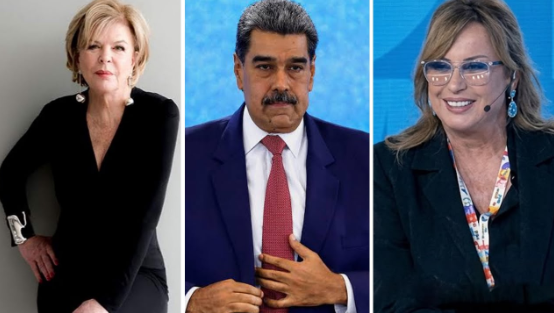
A bitter international inheritance battle involving the estimated $10 billion fortune of late Venezuelan billionaire Oswaldo Cisneros has reached the Supreme Court of Barbados, where his daughter Maria Ela Cisneros Fontanals is pursuing legal proceedings against her stepmother, Mireya Dafne Blavia Gómez de Cisneros, amid growing disputes over the family’s inheritance, trusts, business empire, carrying allegations of tax fraud, manipulation, failed commitments and corruption at Digitel.
The case represents another legal challenge involving the billionaire’s widow, whose position in the family inheritance arrangements has been contested by daughters from Oswaldo Cisneros’s earlier marriage. Maria Ela Cisneros Fontanals has become the latest daughter of Venezuelan billionaire Oswaldo Cisneros to take legal action against her stepmother, Mireya Dafne Blavia Gómez de Cisneros, a strong ally of former Venezuela President Nicolás Maduro, over the $10 billion inheritance dispute.
Official court records confirm that Maria Ela Cisneros Fontanals is the claimant and Mireya Dafne Blavia Gómez de Cisneros is the defendant in Case CIV0938/2024, listed before Justice Bryan Weekes at the Supreme Court of Barbados in Bridgetown this week.
The Barbados litigation comes against the backdrop of a prolonged family dispute over the estate of Oswaldo Cisneros, who died in November 2020, leaving behind extensive business interests in telecommunications, oil, real estate and other sectors. At the centre of the controversy are his three daughters from his marriage to Cuban-born art collector and businesswoman Ella Fontanals-Cisneros: Maritza Blanca Cisneros Fontanals, Claudia Susana Cisneros Fontanals and María Ella Cisneros Fontanals. The daughters have been involved in a wider succession dispute concerning inheritance rights and the participation of six children adopted by Oswaldo Cisneros and his third wife, Mireya Blavia.
Oswaldo married Mireya in 1999. During their marriage, the couple adopted six children from Romania and Colombia: Carmen Elena, Camila Roxana, Alfonso Olaf, Oswaldo Antonio, Laura Gissel and Carla Giovana. According to Venezuelan Supreme Tribunal of Justice records, Oswaldo Cisneros left a will naming Mireya and all nine children as his heirs, with provisions for the estate to be divided equally among them.
However, the inheritance arrangements subsequently became the subject of legal challenges, with Claudia Susana Cisneros Fontanals disputing the standing of the adopted children in Venezuelan succession proceedings. In August 2021, Claudia secured a significant ruling from the Social Cassation Chamber of Venezuela’s Supreme Tribunal of Justice, which found that foreign adoption judgments had not undergone the legal recognition procedure known as exequátur and consequently excluded the adopted children from participating in certain proceedings. That decision was subsequently overturned.
In January 2022, the Constitutional Chamber annulled the earlier ruling, holding that qualifying international adoptions recognised under the Hague Convention did not require the additional procedure demanded by the Social Cassation Chamber.
Claudia has also filed a criminal complaint in Venezuela alleging private violence, extortion and association to commit crimes by his stepmother Mireya Dafne Blavia Gómez de Cisneros.
Venezuelan government sources have accused Mireya Blavia de Cisneros of failing to meet financial and investment obligations associated with the family’s extensive commercial interests. Officials have alleged that the family’s estate was valued by Venezuela’s SENIAT tax authority at more than $10 billion, with a potential inheritance-tax liability exceeding $3 billion.
One official claimed there was no record of the tax having been paid and alleged that authorities were examining whether the family trust and succession arrangements had been manipulated to secure greater control over the estate. The
The scrutiny has also extended to Digitel, one of Venezuela’s principal telecommunications operators, and the family’s oil and real-estate interests. Government sources have alleged that investment commitments were neglected for years while substantial revenues continued to be generated from businesses associated with the Cisneros family.
A former senior executive who previously worked on behalf of Mireya alleged that major businesses had been treated as a source of cash rather than receiving the infrastructure investment required to sustain their operations. The former executive claimed that repeated warnings about underinvestment and management failures had been ignored.
Separately, Venezuelan government sources have alleged that Mireya maintained close political and commercial connections with former president Nicolás Maduro and individuals associated with his administration. Some officials have made further allegations involving bribery, improper political influence and links to criminal networks.
A legal source working for Mireya acknowledged that some family businesses had experienced management problems, insufficient investment and difficulties fulfilling commercial commitments, but attributed those problems partly to US sanctions affecting Venezuela’s financial system. The source said Mireya’s representatives were aware of the scrutiny and intended to cooperate with the authorities.
Disclaimer: This article is for informational and news-reporting purposes only. Allegations concerning Mireya Cisneros, the inheritance dispute, and tax matters should not be interpreted as established facts unless verified by reliable evidence or official findings. Readers are encouraged to consult credible sources and respect the legal process.