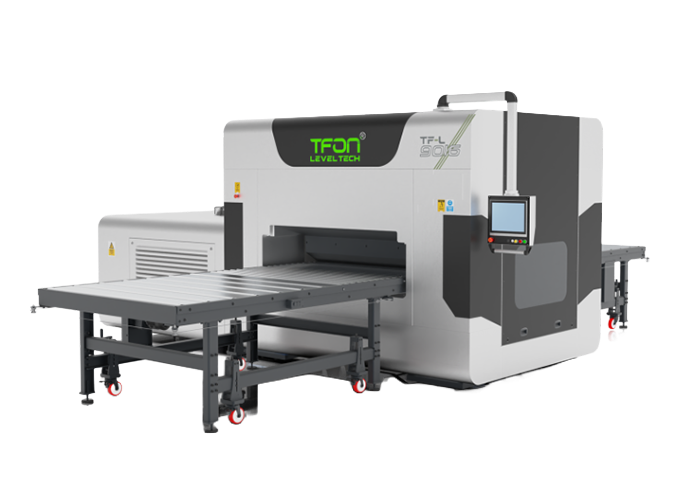
Sheet metal manufacturing has become much more than simply cutting a part and sending it to the next department. Today, manufacturers are expected to manage several stages with greater control, from edge finishing and leveling to bevel preparation and surface treatment. As production volumes increase and factories become more automated, these secondary processes play a larger role in overall efficiency.
TFON develops sheet metal processing machines for companies that need more controlled solutions after cutting operations. Its product range covers different stages of sheet metal finishing, including deburring, edge rounding, leveling, beveling and related surface preparation processes.
The main goal is to help manufacturers prepare components for the next production stage in a more consistent way. A part may leave a laser cutting machine with burrs, another may require leveling because of deformation, while a thick plate may need a prepared bevel before welding. These are different production problems, and each one requires a different solution.
More Than One Process in Sheet Metal Production
Modern sheet metal production usually includes several connected operations.
A component may first be cut with a laser, plasma system, punching machine or another cutting technology. After that, the part may still require additional processing before it is ready for bending, welding, painting or assembly.
This is where dedicated sheet metal processing machines become important.
Deburring machines are used to remove unwanted burrs and attached material from cut edges. Edge rounding equipment can then create smoother contours around the part. Leveling machines are designed to improve flatness, while beveling machines prepare edges for welding applications.
Each process has a different purpose.
For this reason, machine selection should begin with the actual production requirement rather than only the size or thickness of the sheet.
A manufacturer dealing mainly with laser-cut components may focus on fine burr removal and edge rounding. A company processing plasma-cut heavy plates may need a stronger deburring solution. Another manufacturer producing welded structures may place greater importance on bevel preparation.
TFON offers different machine categories so manufacturers can build a production process according to these individual requirements.
Deburring and Edge Rounding Improve Part Preparation
One of the most common challenges after cutting is edge quality.
Even modern cutting technologies can leave small burrs, sharp corners or other unwanted conditions. These may create extra work later in production.
Automatic deburring systems can make this operation more structured by processing suitable parts through defined machine settings.
Depending on the machine configuration, different stations can be used for heavy deburring, standard burr removal, edge rounding and surface finishing.
This allows the production process to be adjusted according to the incoming part.
A laser-cut component with a light burr does not need the same treatment as a plasma-cut part with heavier attached material.
Edge rounding also has an important role.
After the main burr is removed, the edge may still remain sharp. Rounding the edge can help create a smoother component and prepare the part for later processes.
For manufacturers producing repeated components, automatic processing can also improve consistency between different batches.
Leveling and Beveling Solve Different Production Problems
Not every sheet metal problem is related to burrs.
Flatness can become an issue after cutting or previous manufacturing processes. Heat, internal stress and material behavior can cause a plate to develop waves or local distortion.
This may create difficulties in later operations.
A component that is not sufficiently flat can be harder to position during bending, welding or automated assembly.
Leveling machines address this problem by using controlled roller systems to improve the flatness of suitable sheet metal parts.
This can make the component easier to process during the next production stage.
Beveling serves a completely different purpose.
In many welding applications, the edge of a plate needs to be prepared according to a specific joint design.
Instead of manually creating the entire bevel with handheld tools, manufacturers can use dedicated beveling machines to create a more controlled edge geometry.
The required bevel can depend on several factors, including material thickness, joint design, edge length and production quantity.
This is why manufacturers should evaluate the actual drawings and welding requirements before selecting a beveling machine.
TFON develops different beveling concepts according to how the workpiece needs to be processed and handled.
Automation Is Becoming Part of the Finishing Process
Automation has already transformed cutting, bending and welding.
Now, manufacturers are increasingly looking at the operations between these major production stages.
Finishing is one of these areas.
If a laser cutting machine produces components very quickly but every part then waits for manual deburring, the production line can lose some of the efficiency created by the cutting machine.
Automatic sheet metal processing equipment can help reduce this imbalance.
Features such as recipe-based production, automatic thickness measurement, digital controls and controlled station positioning can help operators manage repeated jobs more easily.
When the same component is manufactured regularly, previously established processing parameters can be used again instead of starting from zero.
This becomes particularly useful for companies producing many repeated part numbers.
Conveyor-based systems can also support a more organized material flow.
A component may move from cutting into deburring and then continue toward bending, welding or another production operation.
The objective is not simply to automate individual machines.
It is to create a smoother connection between different stages of manufacturing.
Choosing the Right Machine Starts with the Application
There is no single sheet metal processing machine that is suitable for every manufacturer.
The correct choice depends on the part and the production goal.
Material type should be considered first.
Carbon steel, stainless steel and aluminum may require different processing methods.
The thickness range is also important.
Cutting technology must be reviewed because laser, plasma, punching and oxy-fuel cutting can create different edge conditions.
Part geometry can also influence machine configuration.
Components with internal openings and complex contours may require different finishing tools compared with simple flat plates.
Production quantity should also be evaluated.
A manual or flexible solution can be practical for low-volume custom production, while automatic systems become more attractive as production becomes repetitive.
The final condition of the component is equally important.
Manufacturers should decide whether they need basic burr removal, smoother edge rounding, improved flatness, surface preparation or a specific bevel before welding.
This application-based approach helps companies avoid selecting a machine only according to maximum capacity.
Instead, the machine becomes part of the complete production strategy.
TFON’s sheet metal processing portfolio reflects this wider approach to metalworking.
Rather than concentrating on one operation, the company provides machinery for several stages that take place after cutting and before final fabrication.
As factories continue to invest in faster and more automated production technologies, these intermediate operations will become increasingly important.
Efficient manufacturing depends on more than the first machine in the line.
Every stage must prepare the component correctly for what comes next.
With deburring, edge rounding, leveling and beveling solutions, sheet metal processing machines can help manufacturers create a more controlled and connected production flow.